


This week's announcement that Iran plans to provide Russia with “hundreds” of drones, some of them weapons-capable, for use in Ukraine shines a spotlight on Tehran’s well-established and fast-growing unmanned aerial vehicle (UAV) programme.
Iran has neither confirmed nor denied the US claim but Iranian Foreign Minister Hossein Amirabdollahian noted that Tehran has “various types of collaboration with Russia, including in the defence sector”.
He also said Tehran “won't help either of the sides involved in this war because we believe that it needs to be stopped”.
Any supplies from Iran’s drone programme could provide Moscow with a significant boost in Ukraine at a relatively low financial and combat cost.
Unlike Russia, which spent most of the Cold War building its nuclear and conventional weapons arsenals, Iran invested in a drone programme starting in the 1980s at the height of its war with Iraq.
Four decades later, Iran’s drone capability is unmatched in the Gulf region. A report from the Royal United Services Institute think tank showed that Tehran produces at least five families of drones: Shahed, Fotros, Ababil, Saeqeh and Mohajer.
On Friday, Iran announced its first drone division in the Indian Ocean and published images of drones being launched from a submarine. Reuters reported that Iran did not say how many vessels or drones were included in each unit, only that one ship could carry 50 drones.
Seth Frantzman, a Middle East analyst and author of Drone Wars, saw news of the proposed Iranian sale to Russia as an acknowledgement that Tehran’s UAV programme now has a global footprint.
“In the past, Iran provided drones to Venezuela, Ethiopia and also to militias and proxies in Lebanon, Syria, Iraq and Yemen,” Mr Frantzman told The National. “Now we are talking about Iran's drones proliferating globally to yet another war — in Europe.”

The expert assessed that sanctions had previously been a deterrent against sales of Iranian weaponry, leading to drones from the country not being produced in large numbers.
But that has changed in the past five years.
“We have seen an exponential increase in Iran’s construction of various types of drones in the Shahed, Ababil and Mohajer lines,” Mr Frantzman explained.
“Each of these lines of drones has a number of different types, including smaller kamikaze drones like the Shahed-136.”
Many of those drones come under the operational leadership of the Iranian Revolutionary Guard Corps (IRGC) and have been deployed in attacks against western and Gulf interests in the Gulf of Oman.
For Russia, Iranian drones represent a “cheap and expendable” means to pursue some of its air attacks in Ukraine.
“This could be modelled on how Iran used drones and cruise missiles to attack Saudi Arabia’s Abqaiq facility in 2019, or how Azerbaijan used drones against Armenian forces in Karabakh in 2021 to suppress Armenian air defences and then systematically destroy their armour and artillery,” Mr Frantzman said.
In June 2020, a UN report blamed Iran for supplying drones to Houthi rebel militias in Yemen, which were used to destroy critical oil infrastructure at Abqaiq.
In Ukraine, Russia could employ similar tactics against western-supplied weapons such as the US High Mobility Artillery Rocket Systems (Himars).
However, Ukraine receives its own drone supplies from Turkey and the US, and Washington could go a step further by supplying Ukraine with a system that disables drones.
Several anti-drone technologies exist and in February, The Defence Post reported that Naval Information Warfare Centre engineers are developing a system that detects, identifies and neutralises low-altitude weapons, including UAVs.
Further illustrating how far anti-drone technology has come, US President Joe Biden this week visited an Israeli Iron Beam laser unit that can take out UAVs and other incoming threats.
Mr Frantzman suspects the Ababil and Shahed-136 drones are most likely to make up the Iranian sale for Russia, granting Moscow more “loitering munitions that can be used in kamikaze attacks”.
“The Ababil-type drones often have ranges of several hundred kilometres,” he said.
Asked if such sale would be a game-changer, Mr Frantzman saw it as unlikely.
“Drones don’t win wars, however they can provide a country with a kind of instant air force,” he said.
The Ukrainian military said that Russia has lost more than 200 planes and 184 helicopters in the course of the invasion that started on February 24.
-
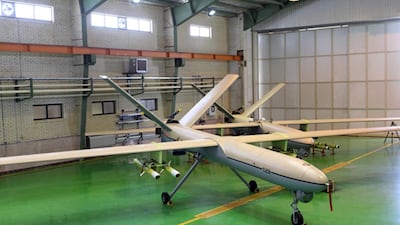
A photo released by Iran's Revolutionary Guards in 2013 shows a newly made "Shahed 129" drone in Tehran. SEPAH NEWS via AFP) -
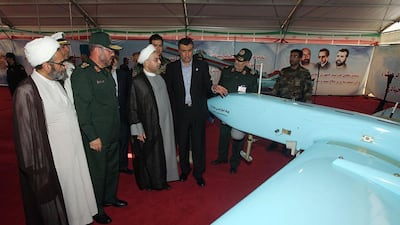
President Hassan Rouhani views a display of Iran's Mohajer 4 drone as part of Iran's defence capabilities exhibition inside the defence ministry building in Tehran on August 24, 2014. Iranian Presidency Website via AFP -
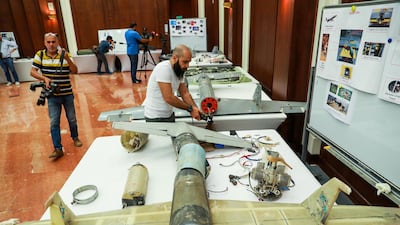
Weapons supplied by Iran to the Houthi militias in Yemen were put on display at a press conference by the Saudi-led Arab coalition on Tuesday. Victor Besa / The National -

Iranian weapons that have been used in Yemen. A shot down drone on display. Victor Besa / The National -
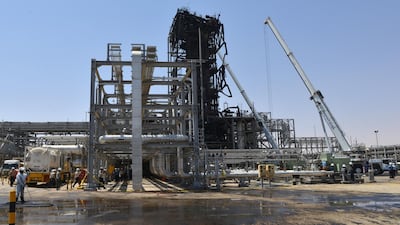
Employes of Aramco oil company stand near a heavily damaged installation in Saudi Arabia's Khurais oil processing plant on September 20, 2019. AFP -
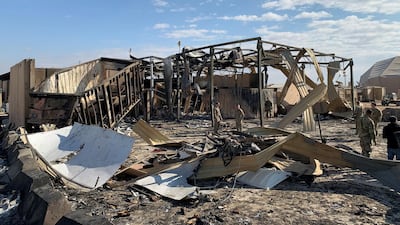
Damage at the Ain Al Asad military airbase housing US and other foreign troops in the western Iraqi province of Anbar after an Iranian missiles attack at the sprawling airbase. AFP



